
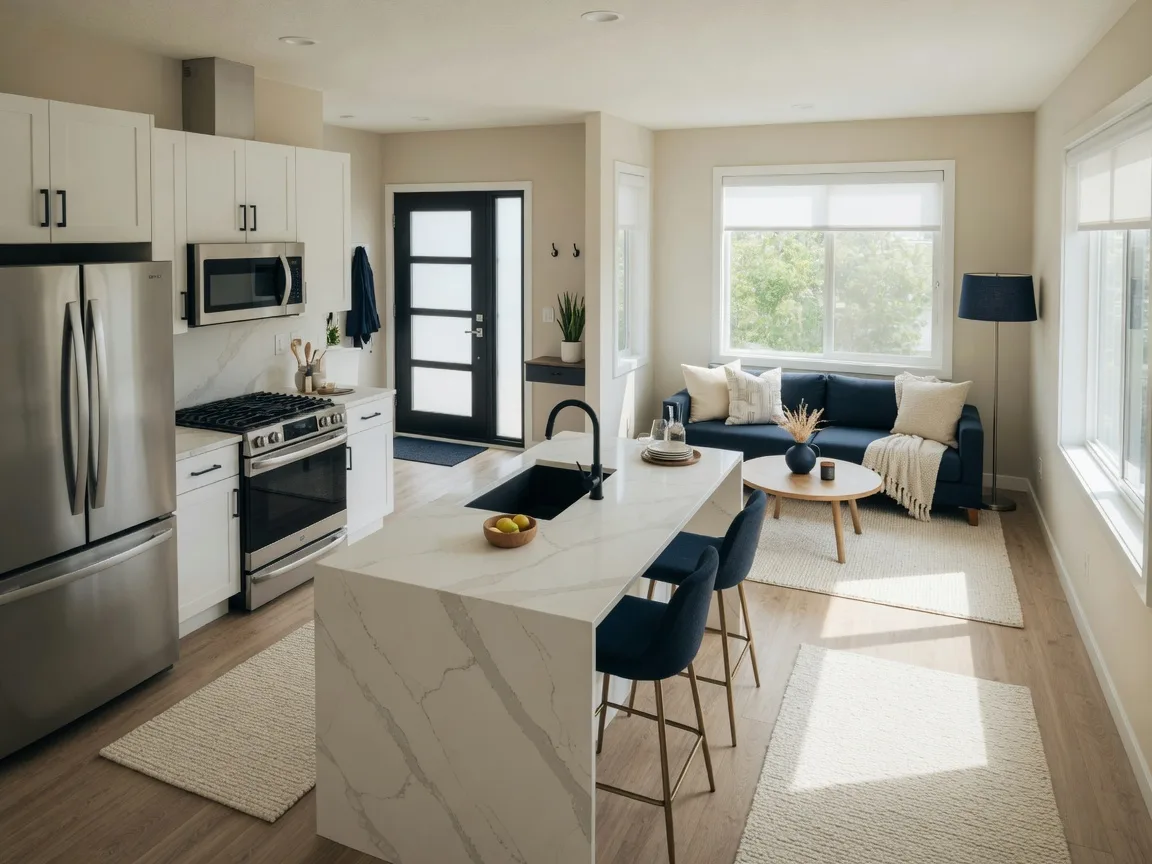
A house with a legal secondary suite in Victoria can add $1,500 to $2,200 a month in rental income, and that income can help you qualify for roughly $130,000 to $150,000 more mortgage than you would get without it. But only if the suite is legal. An unauthorized suite can kill your financing, void your insurance, and leave you with a property the bank does not want to lend against. Here is what to look for and how to buy safely.
The six things every buyer should verify before making an offer on a home with a rental suite:
1. Does the suite have a valid occupancy permit from the municipality?
2. Is the fire separation up to code (30-minute fire-rating between units)?
3. Are ceiling heights at least 2 metres (6 feet 7 inches)?
4. Does each unit have its own electrical panel and separate metering?
5. Can the rental income be counted by your lender toward your mortgage qualification?
6. Has the current owner disclosed the suite to their insurance provider?
Why the Legal Status of the Suite Is the Most Important Question
A legal secondary suite in Victoria has a paper trail. The owner obtained permits from the city for the construction. A building inspector signed off on the work. The city issued an occupancy permit that says the suite is approved for habitation. If the seller cannot produce that paper trail, the suite is likely unauthorized, and the risks transfer to you as the buyer.
Unauthorized suites are common in Victoria. Plenty of older homes have basement apartments that were built decades ago without permits. Some are well built and perfectly safe. Some are not. The problem is that lenders treat them differently. A bank may refuse to count rental income from an unauthorized suite toward your mortgage qualification. Some lenders may decline the loan entirely. And if the city discovers the suite and issues a bylaw violation order, you become responsible for bringing it up to code or removing it, at your own cost.
How Does Rental Income Affect Your Mortgage Qualification?
BC lenders typically count 50 to 80 percent of gross suite rent as qualifying income. The exact percentage depends on the lender, the type of mortgage, and whether the suite is legal. CMHC-insured mortgages require at least two separate, legal units before they will count rental income at all. For a conventional (uninsured) mortgage, the rules vary. A typical Victoria suite renting for $1,800 a month could add $130,000 to $150,000 to your buying power if the lender counts 75 percent of that income. That is a significant boost for buyers who are stretched on a single income.
The catch is that the rental income needs to be documented. If the seller currently has a tenant, their lease agreement and rent receipts provide the evidence the lender needs. If the suite is vacant, the lender may still consider potential rental income based on comparable market rents, but that is less certain. We have seen deals fall apart because the lender would not count the income without a signed lease in place.
What Insurance Do You Need for a Suite?
Standard home insurance does not cover a rental suite. This is one of the most common gaps Victoria buyers discover after closing. You need landlord or rental suite coverage, which adds protection for liability, the suite itself, and tenant-related risks. An unauthorized suite may not be insurable at all, or the premiums may be significantly higher.
Call your insurance provider before you remove subjects, not after. Ask them specifically whether they will insure a property with a secondary suite, what the premium difference is, and whether they require the suite to be legally permitted. The GVREALTORS association has a helpful guide on this, and the answer depends on the insurer. Some will insure an unauthorized suite. Most will not, or will do so with exclusions that make the coverage less useful.
What Are the Key Due Diligence Items?
When you find a home with a rental suite, here is what your Realtor and home inspector should be checking. First, the building permits and occupancy permit from the municipality. The city of Victoria keeps a searchable online permit database, and a quick look will tell you whether any permits were pulled for the work. Second, the fire separation between units. Building code requires a minimum 30-minute fire-rated separation between a main dwelling and a secondary suite. Your home inspector can check for fire-rated drywall, proper sealing around penetrations, and the right kind of doors.
Third, the ceiling height. Legal suites in Victoria require at least 2 metres (6 feet 7 inches) of clear height in all habitable rooms. Short basement suites are common in older homes, and anything less than the minimum fails the occupancy requirements. Fourth, the egress windows. Each bedroom in a suite needs a window large enough to escape through in an emergency. The rough rule is that the opening must be at least 0.35 square metres and no more than 1.5 metres off the floor. Your inspector will know what to look for.
Fifth, the electrical and mechanical separation. Ideally, each unit has its own electrical panel. Some older setups have the suite on a sub-panel of the main residence, which can make it harder to separate utility costs. Sixth and finally, the rental history. Ask the seller for the lease agreement, rent receipts, and a record of any repairs or issues with the suite. A current tenant in place is generally a good sign, but check the BC Residential Tenancy rules on what happens to the tenancy when the property sells.
Important Disclaimer
This guide summarizes practical considerations for buying a home with a secondary suite in Victoria BC, but it is not legal, financial, or insurance advice. Municipal regulations, lender policies, and insurance requirements vary and change. Always verify current rules with your municipality, your lender, and your insurance provider before making an offer. We are real estate agents, not lawyers, financial advisors, or insurance brokers. Verify all details with licensed professionals.
What About Property Taxes and Rental Income Tax?
A legal suite may trigger a modest property tax reassessment, but the increase is typically small compared to the rental income. Your principal residence exemption may also be partially affected if more than 50 percent of the property is used for rental purposes, though that is rare with a single secondary suite. Talk to an accountant before you close. Rental income is taxable, and you want to understand your obligations before the first rent cheque arrives.
The BC government offers a homeowner grant for principal residences that reduces property taxes, and as long as you live in the main unit, you still qualify. The suite does not eliminate the grant. But if you ever convert the entire property to rentals and move out, you lose the grant on that property. Keep that in mind if you are planning a full conversion in the future.
Is a Suited Property Always a Better Deal?
Not necessarily. A home with a legal suite will typically sell for a premium over an identical home without one. The premium reflects the rental income, and the asking price has usually been set with that income in mind. So you are not getting a discount. You are paying for income-producing potential. The question is whether the numbers work for you.
Run the math. What would the monthly mortgage payment be on the premium price? Add the property taxes, insurance, maintenance, and a vacancy allowance (realistic landlords budget 5 to 10 percent vacancy). Subtract the expected rental income. If the net cost is lower than what you would pay for a comparable home without a suite, the property makes financial sense. If the numbers are close, the suite becomes more of a lifestyle benefit than a financial one, and that is fine too, as long as you know that going in.
Looking for a Home With a Legal Suite?
We have helped dozens of buyers in Victoria and the West Shore find properties with legal secondary suites that actually pencil out. We know which neighbourhoods have the best inventory, and we know the questions your lender and inspector will ask. If you are ready to start looking, let us talk about what you need.
Schedule a call with usThe Bottom Line for Buyers
A home with a legal secondary suite can be a smart buy. The rental income helps with the mortgage, the property has built-in flexibility, and in a market like Victoria, a suited home is often easier to resell later because the next buyer will see the same income stream you did. But none of that applies if the suite is unauthorized or the due diligence was skipped. Verify the permits, confirm the insurance, and run the numbers with your lender before you commit.
And if you are looking at buying a property where you might build a suite later rather than buy one already built, check our guide on which Greater Victoria municipalities have the best rules for adding a secondary suite. The answer depends a lot on where you buy.