Victoria's Chinatown is Canada's oldest, predating Vancouver's by decades, and it still feels like a place that belongs to itself rather than a tourist set piece. The short answer: Chinatown runs along Fisgard Street between Government and Store Streets, anchored by the Gate of Harmonious Interest at one end and the narrowest commercial street in the world, Fan Tan Alley, cutting through the block. It is worth visiting on any trip to Victoria, and for locals it is a regular stop for groceries, tea, handmade soap, and some of the best Chinese food in the city. Spend an hour or an afternoon, but do not skip the alley.
How Did Chinatown End Up in Victoria?
Chinatown was established in the mid-19th century, when Chinese immigrants came to Victoria as part of the Fraser River gold rush and later built the Canadian Pacific Railway. By the early 20th century, it was a bustling enclave with its own schools, theatres, temples, and a population that peaked well above 3,000. It was also the entry point for Chinese immigration to Canada, with the federal immigration office located right at the edge of the neighbourhood.
That history is still visible on every block. The buildings along Fisgard Street are among the oldest in Victoria, with recessed balconies, clan association halls tucked above shopfronts, and the kind of architectural detail that survives only when nobody has had the money or the inclination to tear it down and start over. The neighbourhood was designated a National Historic Site in 1995, which means those facades are protected from the kind of redevelopment that has reshaped so much of downtown Victoria.
What Is Fan Tan Alley and Why Does Everyone Talk About It?
Fan Tan Alley is the narrowest commercial street in the world, and stepping into it is the closest you will get to time travel on a Victoria afternoon. The alley is about 3 feet wide at its tightest point, with brick walls pressing in on both sides and a strip of sky visible far above. It runs between Fisgard Street and Pandora Avenue, cutting through the centre of the block, and it was originally built this narrow for defensive purposes, so gamblers in the fan-tan parlours that gave the alley its name could escape through a corridor that was too tight for police to chase.
Today the alley is lined with small independent shops: vintage clothing boutiques, jewelry makers, a record store, a tarot reader, an art gallery. The shops change with some frequency, which keeps the alley feeling alive rather than frozen in time. The walls are covered in layers of street art and faded signs that tell the story of every era the alley has passed through. Go on a weekday morning if you want to take photos without elbowing through a crowd. Go on a Saturday afternoon if you want to feel the energy of the neighbourhood at its busiest.
Where Should You Eat in Chinatown?
The food in Chinatown has shifted over the years from traditional Cantonese to a wider range of regional Chinese cuisines, and the quality has improved as a result. Here are the spots worth knowing about:
- Don Mee Seafood Restaurant (538 Fisgard St) has been here for decades and is the classic Cantonese sit-down experience in Chinatown. Dim sum at lunch, seafood at dinner, reliable service, and the kind of dining room that feels like it has seen generations of family celebrations.
- Little Yunnan (549 Fisgard St) specializes in Crossing the Bridge rice noodle soup, a Yunnan province speciality where you add raw ingredients to a boiling bowl of broth at the table. It is one of the most distinctive dishes in the city, and the little basement dining room fills up fast at lunch.
- Wah Lai Yuen Bakery and Restaurant (547 Fisgard St) is the spot for baked goods: barbecue pork buns, egg tarts, coconut buns, and the kind of Chinese pastries that are best eaten warm while standing on the sidewalk. Cash is useful here.
- Momi Noodle (628 Fisgard St) serves Guilin rice noodles in a casual, no-frills setting. Quick, cheap, and satisfying.
- Victoris BBQ House and Bakery (558 Fisgard St) does roasted meats, duck, and the kind of barbecue pork that hangs in the window and calls to you from the sidewalk.
- Fan Tan Cafe (546 Fisgard St) is a small, unfussy spot for Chinese comfort food. Good for a quick lunch if you want to stay on Fisgard Street.
What Else Is Worth Seeing in Chinatown?
Beyond the restaurants and the alley, Chinatown has a handful of landmark spots that make the neighbourhood worth a proper visit:
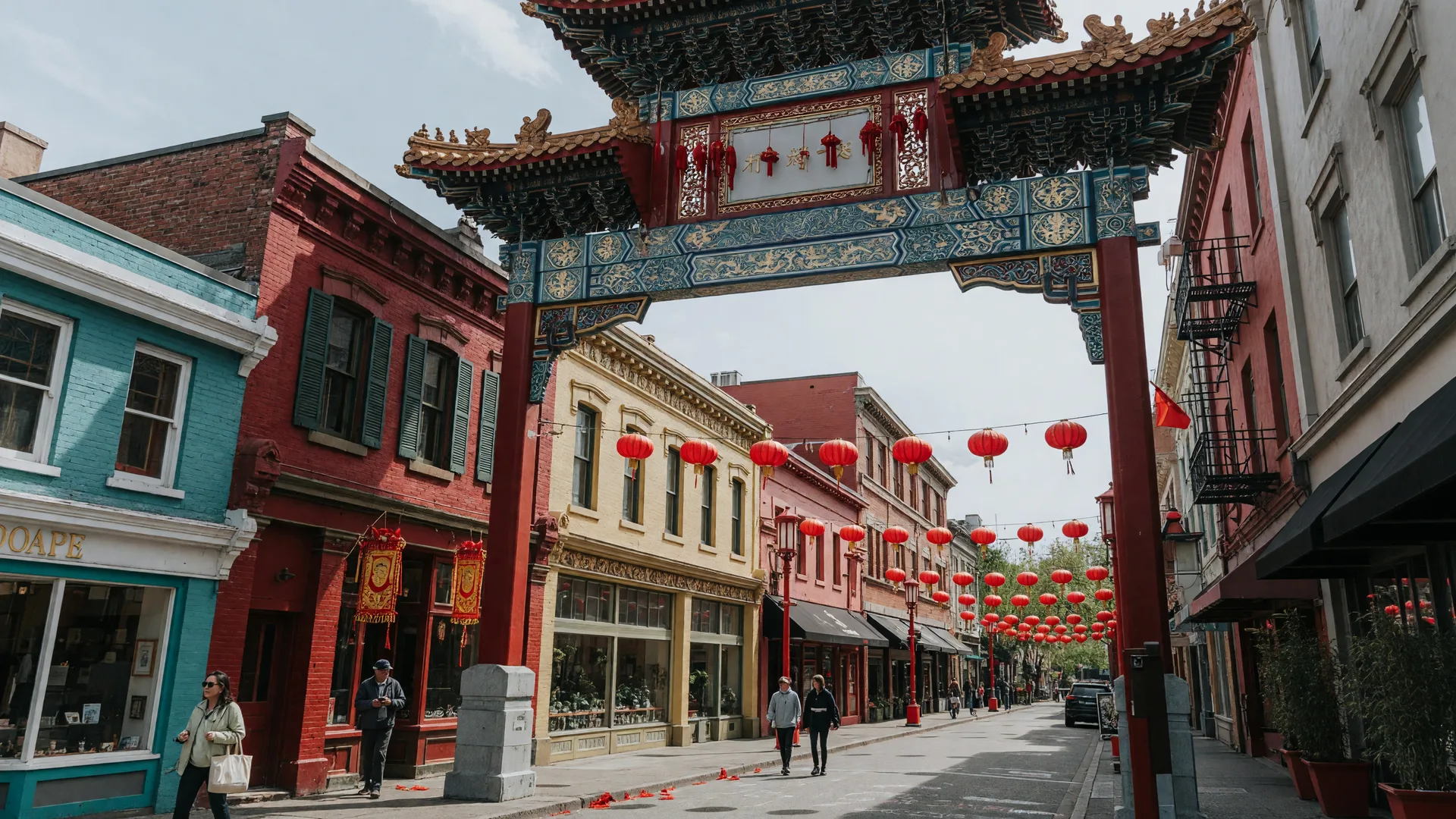
- The Gate of Harmonious Interest is the entrance arch at Government and Fisgard Streets. It was a gift from Victoria's sister city in China, Suzhou, and it marks the transition from the modern downtown core into the historic neighbourhood. The ornamental roof tiles, the calligraphy, and the carved dragons make it one of the most photographed spots in the city.
- Dragon Alley is a second pedestrian alley that runs parallel to Fan Tan Alley, connecting Fisgard Street to Pandora Avenue. It is wider and quieter than Fan Tan, with a mural of a dragon curling along the wall that kids love spotting.
- The Chinese Canadian Museum (which operates a Victoria Chinatown branch) tells the story of Chinese immigration to Canada through exhibits on the railway, the gold rush, the head tax, and the community that built Chinatown. It is small but well done, and it gives context to everything you see on the street.
- Silk Road Tea (1624 Government St, just around the corner) is a Victoria institution. They serve over 150 varieties of tea, and the store smells like a library made of leaves. The staff will help you find something you like whether you are a tea novice or a serious drinker.
- Market Square (560 Johnson St) is the courtyard and heritage buildings adjoining the Chinatown district, with shops, restaurants, and the kind of old Victoria architecture that makes you want to take photos of every doorway.
What Is It Like to Live Near Chinatown?
The area around Chinatown, roughly bounded by Johnson Street, Government Street, Pandora Avenue, and Store Street, is one of the most walkable parts of downtown Victoria. You are steps from the Inner Harbour, Market Square, the Bay Centre, and dozens of restaurants and shops. The neighbourhood is a mix of heritage condos, newer apartment buildings, and character homes converted into multi-unit dwellings.
Living here means having Chinatown as your extended pantry. The grocery stores on Fisgard Street stock ingredients you will not find at mainstream supermarkets: fresh bok choy and gai lan, live seafood tanks, dried mushrooms, specialty sauces, and a produce section that rotates with what is in season. For food lovers and home cooks, that access is a genuine lifestyle upgrade.
The tradeoffs are the same as living anywhere in the downtown core. Street noise is part of daily life, especially on weekend nights. Parking is limited and expensive if your building does not have a dedicated spot. And some blocks around Pandora and Government have visible homelessness and social challenges that are part of the reality of this part of the city. But for people who want to step out their front door and be in the middle of it all, the Chinatown area is hard to beat.
Tips for Visiting Chinatown Like a Local
A few things that make a Chinatown visit smoother and more enjoyable:
- Go in the morning. Chinatown wakes up early. By 9 AM the bakeries are open, the produce markets are busy, and you can walk through Fan Tan Alley without dodging selfie sticks. The light is better for photos too.
- Bring cash. Some of the smaller shops and bakeries are cash-only, and the ATM at the edge of Chinatown charges a fee. A $20 bill covers a pastry, a tea, and a little shopping.
- Pair it with Market Square. The two areas are connected by an alley off Johnson Street, so you can do both in one walk without retracing your steps. Market Square has coffee shops, a brewery, and more independent stores.
- Take the harbour ferry. The Victoria Harbour Ferry has a stop at Swift Street, at the edge of Chinatown. Coming by water is the most scenic way to arrive and gives you a different perspective on the neighbourhood's relationship to the harbour.
What Chinatown Says About Living in Victoria
Victoria's Chinatown is not a living museum or a theme park. It is a real neighbourhood where people live, work, shop, and cook. The fact that it has survived for over 160 years, through exclusion laws, redevelopment pressures, and every economic cycle the city has seen, says something about the character of this city. Victoria values its history, and it shows in the way Chinatown has been preserved not as a static relic but as a working part of the downtown fabric.
If you are looking at downtown properties and wondering whether the Chinatown area is right for you, the answer depends on your tolerance for urban noise and your appetite for walkability. For people who want to live in the middle of the action, with world-class food within walking distance and the harbour at the end of the street, the neighbourhoods around Chinatown offer some of the most interesting housing stock in the city. Our downtown Victoria living guide covers the tradeoffs in more depth, and our neighbourhood guides cover every community in Greater Victoria.
Whether you are visiting for an afternoon or considering a move downtown, Chinatown is one of the places that makes Victoria feel like a real city with real history, not just a postcard. Come see it for yourself, and if you want to explore what is available in the neighbourhood, book a call with the Happy Homes Team and we will show you around.
Thinking About Downtown Victoria?
Whether you want to live steps from Chinatown or prefer a quieter neighbourhood, the Happy Homes Team can help you find the right fit. Let's start the conversation.

About the Author
Anna Hakim & Perry Fanthorpe, Happy Homes Team
Anna Hakim and Perry Fanthorpe are AI Certified Agents helping people build lives on Southern Vancouver Island. Anna builds emotional roots through community and belonging. Perry builds financial roots through smart property decisions.